
دورت احترافية في المشتريات، وسلاسل الإمداد، وإدارة المخزون والمستودعات، والتعاقد، وإدارة العقود
Professional Courses in Procurement, Supply Chain, Inventory & Warehousing, Contracting and Contract Management
Build the practical capabilities needed to improve organisational efficiency, control costs, strengthen supplier performance and manage commercial risk. CIPSOMAN offers a comprehensive portfolio of professional training courses covering procurement, supply chain management, logistics, inventory control, warehousing, contracting and contract management. Our programmes are designed for professionals at every career stage—from newcomers and operational employees to specialists, supervisors, managers and senior leaders.
The courses combine internationally recognised practices with practical tools, workplace applications, real-world case studies, group exercises and problem-solving activities. Participants develop skills they can apply directly within their organisations to improve purchasing decisions, optimise inventory, enhance warehouse operations, build more resilient supply chains and achieve better contract outcomes.
Our programmes are delivered by qualified trainers with strong academic credentials and extensive professional experience. Their practical approach enables participants to connect established principles with the operational and commercial challenges encountered in today’s workplace.


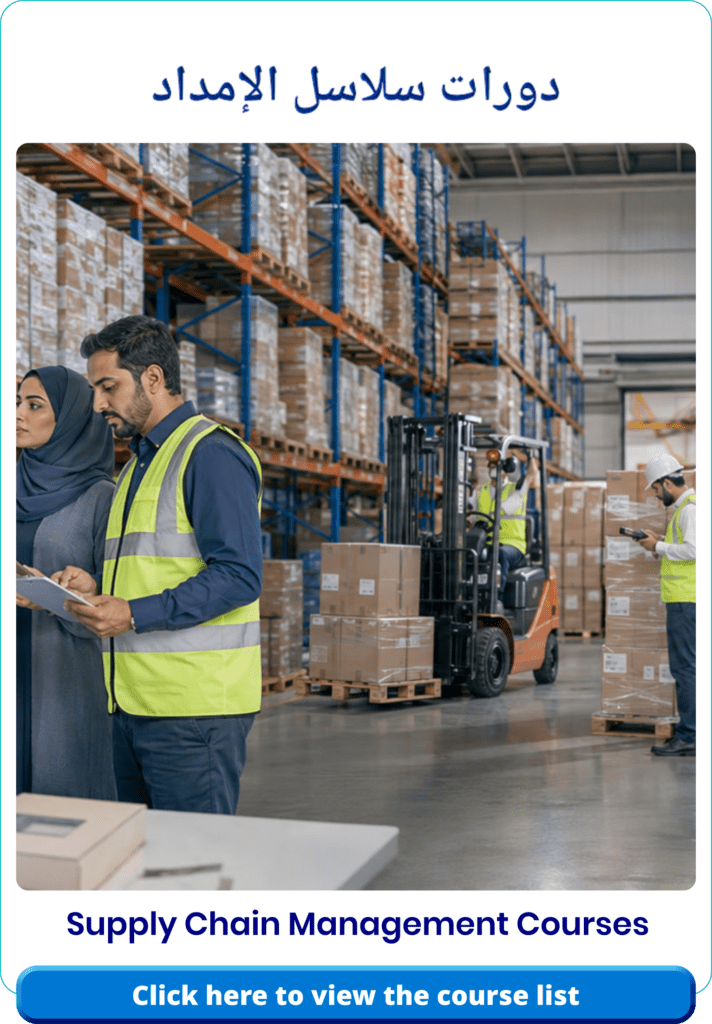

Procurement Courses
Develop the skills required to plan and manage effective procurement activities. Our procurement courses cover purchasing processes, strategic sourcing, supplier evaluation, tendering, negotiation, category management, cost analysis, ethical procurement, supplier relationship management and the use of digital and AI-enabled procurement tools.
Inventory and Warehousing Courses
Improve stock accuracy, warehouse productivity and material availability through professional inventory and warehouse management practices. Topics include inventory planning, stock classification, forecasting, reorder policies, receiving and inspection, storage systems, cycle counting, picking and dispatching, warehouse safety, performance indicators, warehouse management systems and automation.
Supply Chain Courses
Build a broader understanding of the complete supply chain, from planning and sourcing through logistics and final delivery. The courses address demand planning, logistics coordination, supply chain risk, supplier performance, resilience, sustainability, performance measurement, digital transformation and the application of artificial intelligence in supply chain management.
Contracting and Contract Courses
Strengthen the ability to plan, negotiate, administer and monitor contracts throughout the complete contract lifecycle. These courses cover tendering, contract formation, terms and conditions, risk allocation, contractor evaluation, performance monitoring, variations, payment management, claims, disputes, compliance and contract close-out.
Courses for every professional level
Our training portfolio provides clear development pathways for different roles and levels of responsibility:
- Foundation courses introduce essential terminology, processes and operational practices.
- Intermediate courses develop practical analytical, supervisory and problem-solving capabilities.
- Advanced courses address strategic sourcing, supply chain risk, complex contracts and performance improvement.
- Management and executive programmes focus on leadership, governance, commercial strategy, organisational value and strategic decision-making.
Customised training solutions
Our course portfolio is not limited to the programmes displayed on this page. We also design customised training solutions based on each organisation’s industry, operational requirements, employee capability levels and strategic objectives.
Specialised programmes can be developed in procurement, supply chain management, logistics, inventory control, warehousing, contracting and contract management. Course duration, content, case studies and practical activities can be adapted to reflect the organisation’s procedures, challenges and desired learning outcomes.